Ethio Telecom has launched the eighth edition of its nationwide Green Legacy campaign.
The company is planting 250,000 tree seedlings across Ethiopia. The campaign is running simultaneously in Addis Ababa and across all 18 of the operator’s regional offices.
More than 3,500 employees and partners took part in planting events at the same time.
It is the latest chapter in a sustainability programme that now extends well beyond tree planting, into solar energy, electric vehicles, and green data centres.
Seven Years of Planting, 4.6 Million Trees
The Green Legacy programme did not begin this year. Ethio Telecom has planted more than 4.6 million trees across Ethiopia over the past seven years. The average reported survival rate stands at 82.7 percent.
That survival rate matters. Tree-planting campaigns across Africa have often been criticised for planting numbers that look impressive but fail to translate into lasting forests.
An 82.7 percent survival rate, if independently verified, represents a genuinely high standard for this type of initiative.
The campaign was launched under Ethiopia’s national Planting Hope initiative.
It also aligns with Ethio Telecom’s own For a Green Ethiopia campaign.
The eighth round is expected to create around 2,000 temporary jobs.
These will cover seedling production, planting, and ongoing maintenance.
The company has allocated more than 42.4 million Ethiopian birr for this year’s programme.
Cumulative investment in environmental protection and green development now exceeds 159.9 million birr.
Solar Sites Replacing Diesel Across the Network
The reforestation story is significant. The renewable energy infrastructure story is equally so.
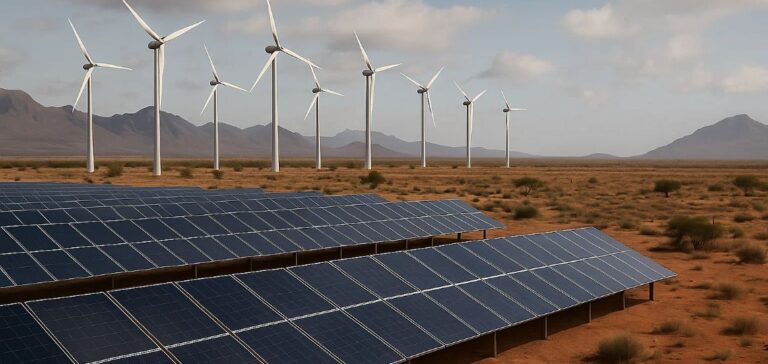
Ethio Telecom has deployed 190 fully solar-powered telecom sites, 867 hybrid solar and battery systems, and 1,114 lithium-ion battery installations nationwide.
These are not pilot projects. They represent a systematic shift in how the operator powers its network.
During the past financial year alone, Ethio Telecom commissioned 215 new solar-powered sites.
It also modernised 774 existing stations. This added 12.72 megawatts of renewable generation capacity.
The company’s total installed solar capacity has now reached 39.72 megawatts.
The significance of this shift is practical as well as environmental.
Diesel-powered base stations are expensive to run. Fuel must be transported to often remote locations.
Supply chains are vulnerable to disruption. Solar and hybrid systems reduce all of these costs while improving network reliability.
According to the International Energy Agency, decentralised renewable energy technologies are expected to play a central role in expanding electricity access across Africa.
Replacing diesel-powered base stations with solar and hybrid systems improves service reliability in areas where electricity supply remains intermittent.
For a country as geographically diverse as Ethiopia, that matters enormously. Getting affordable, reliable connectivity to rural communities has always been constrained by the cost and complexity of powering remote infrastructure. Solar changes that equation.
Electric Vehicles and Clean Mobility
Ethio Telecom’s green ambitions extend beyond its own network infrastructure.
The company has moved into Ethiopia’s emerging electric vehicle charging sector.
Since launching its electric vehicle charging service in February 2025,
Ethio Telecom has deployed nine ultra-fast EV charging stations.
These are capable of charging 108 vehicles simultaneously.
The numbers from this service are already compelling.
Between February 2025 and July 2026, the charging network recorded more than 481,000 charging sessions.
It delivered 11.2 million kilowatt-hours of electricity. The company says this helped avoid approximately 15.4 million kilograms of carbon dioxide emissions.
That is equivalent to the carbon sequestration capacity of more than 76,000 trees.
READ ALSO:
MTN Nigeria and First WATT Renewable Deploy 34 MWp Solar and EV Charging Network Across Eight Cities
The EV charging service is integrated with Telebirr, Ethio Telecom’s mobile finance platform.
That integration turns what might otherwise be a standalone environmental initiative into a revenue-generating digital service accessible to millions of existing customers.
The Strategy Behind the Sustainability
These initiatives are not disconnected. They sit within a deliberate corporate framework.
The reforestation campaign forms part of Ethio Telecom’s Next Horizon: Digital and Beyond 2028 Strategy.
This strategy integrates digital transformation with environmental sustainability through its Green Operator programme.
Ethio Telecom is expanding its renewable energy footprint through additional solar-powered network sites, hybrid power systems, and energy-efficient green data centres.
The company is also implementing intelligent network energy optimisation and circular economy practices.
These include responsible e-waste management, equipment refurbishment, asset recovery, and recycling initiatives.
The Green Operator positioning is increasingly important in the context of global sustainability standards.
Investors, development finance institutions, and international partners increasingly require measurable environmental credentials.
Ethio Telecom is building those credentials systematically.
Africa’s Largest Telecom Gets Greener
Ethio Telecom is the largest telecom provider in Ethiopia. As of January 2026, the company has 87.1 million customers.
That scale means its sustainability choices have proportional impact.
The investments reflect a wider trend across Africa’s telecommunications sector.
Operators are increasingly deploying on-site renewable energy to reduce operating costs and improve resilience in areas with unreliable grid connections.
Ethio Telecom is among the most advanced on the continent in the depth and breadth of this transition.
The company has previously partnered with Huawei on the colocation of solar at tower sites.
That partnership completed its first deployment batch in 2025 and is continuing into the current year.
Why This Model Matters Beyond Ethiopia
What Ethio Telecom is building is a replicable model. It demonstrates that a telecoms operator can simultaneously expand network coverage, reduce operating costs, cut carbon emissions, and contribute to national climate goals, without treating any of these as competing priorities.
The expansion demonstrates how digital infrastructure and climate action can reinforce one another.
It enables cleaner network operations while extending reliable connectivity to rural and off-grid communities through renewable energy rather than conventional diesel-powered infrastructure.
For Africa’s telecoms sector broadly, that proof of concept is valuable.
The continent has hundreds of millions of people who remain unconnected.
Many of them live in areas where grid power is unreliable or absent entirely.
Solar-powered telecom infrastructure offers a path to connectivity that does not require waiting for grid expansion.
Ethio Telecom is showing that path can be walked profitably, at scale, right now.