Cooling systems constitute one of the most critical and energy-intensive components of modern data centres.
Servers, storage devices, and networking equipment generate substantial heat during operation, and effective thermal management is essential to maintain hardware reliability, prevent thermal throttling, and achieve optimal performance.
Traditional air-based cooling remains prevalent, while liquid cooling technologies are gaining adoption for high-density deployments.
Key strategies such as hot aisle/cold aisle containment and efficiency metrics like Power Usage Effectiveness (PUE) guide the design and operation of these systems.
Air Conditioning Systems (CRAC and CRAH Units)
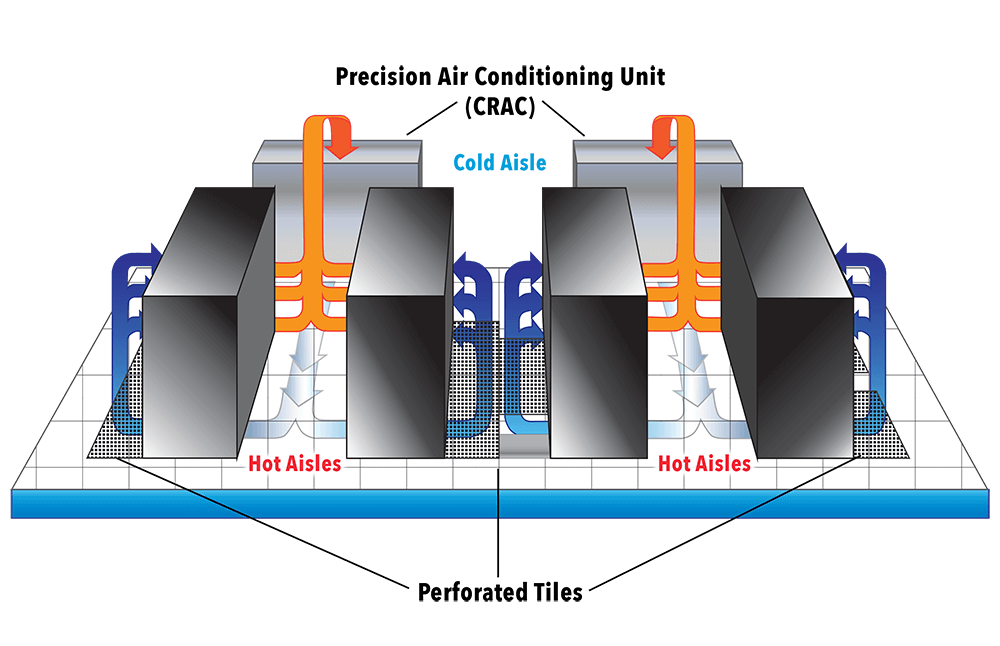
Computer Room Air Conditioning (CRAC) and Computer Room Air Handling (CRAH) units serve as the primary means of air-based cooling in most facilities.
- CRAC Units: Self-contained units that combine refrigeration cycles (compressors, evaporators, condensers) to deliver cold air directly to the space. They are precise, reliable, and commonly used in smaller to medium-sized data centres.
- CRAH Units: Similar in function but rely on chilled water supplied from external chillers, offering greater scalability and integration with central plant systems.
Cold air is typically distributed via raised floors with perforated tiles, allowing conditioned air to rise into server intakes. Return air is collected from the hot exhaust and recirculated after cooling.

Hot Aisle/Cold Aisle Containment
The hot aisle/cold aisle layout organises server racks in alternating rows to optimise airflow and reduce mixing of supply and return air.
- Cold Aisle: Faces the front of servers, receiving cool air from perforated floor tiles or overhead ducts.
- Hot Aisle: Faces the rear of servers, capturing exhaust heat.
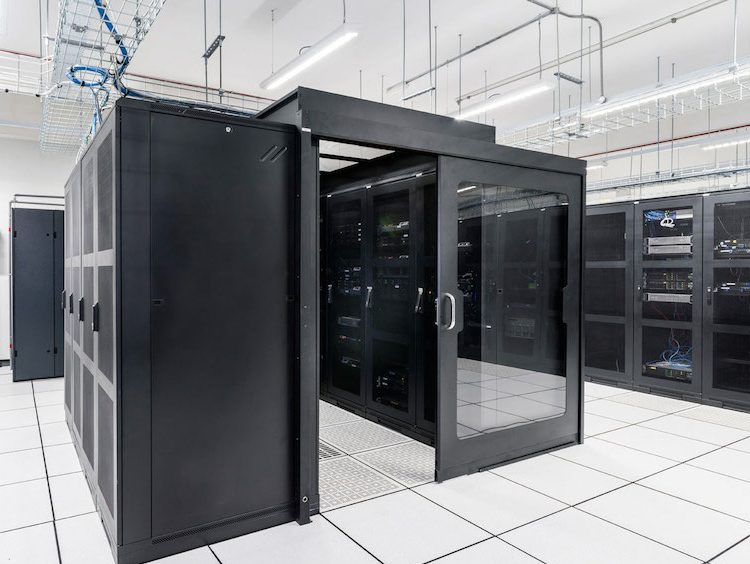
Containment enhances efficiency by enclosing one or both aisles:
- Cold Aisle Containment (CAC): Encloses the cold aisle with doors, ceilings, or panels to direct cool air exclusively to server intakes.
- Hot Aisle Containment (HAC): Encloses the hot aisle, capturing exhaust and directing it to return ducts or CRAC/CRAH intakes.
Containment minimises recirculation, allows higher supply temperatures, and improves overall cooling performance.
Liquid Cooling Basics
As rack densities increase (often exceeding 20–50 kW per rack), air cooling reaches practical limits. Liquid cooling offers superior heat transfer capacity.
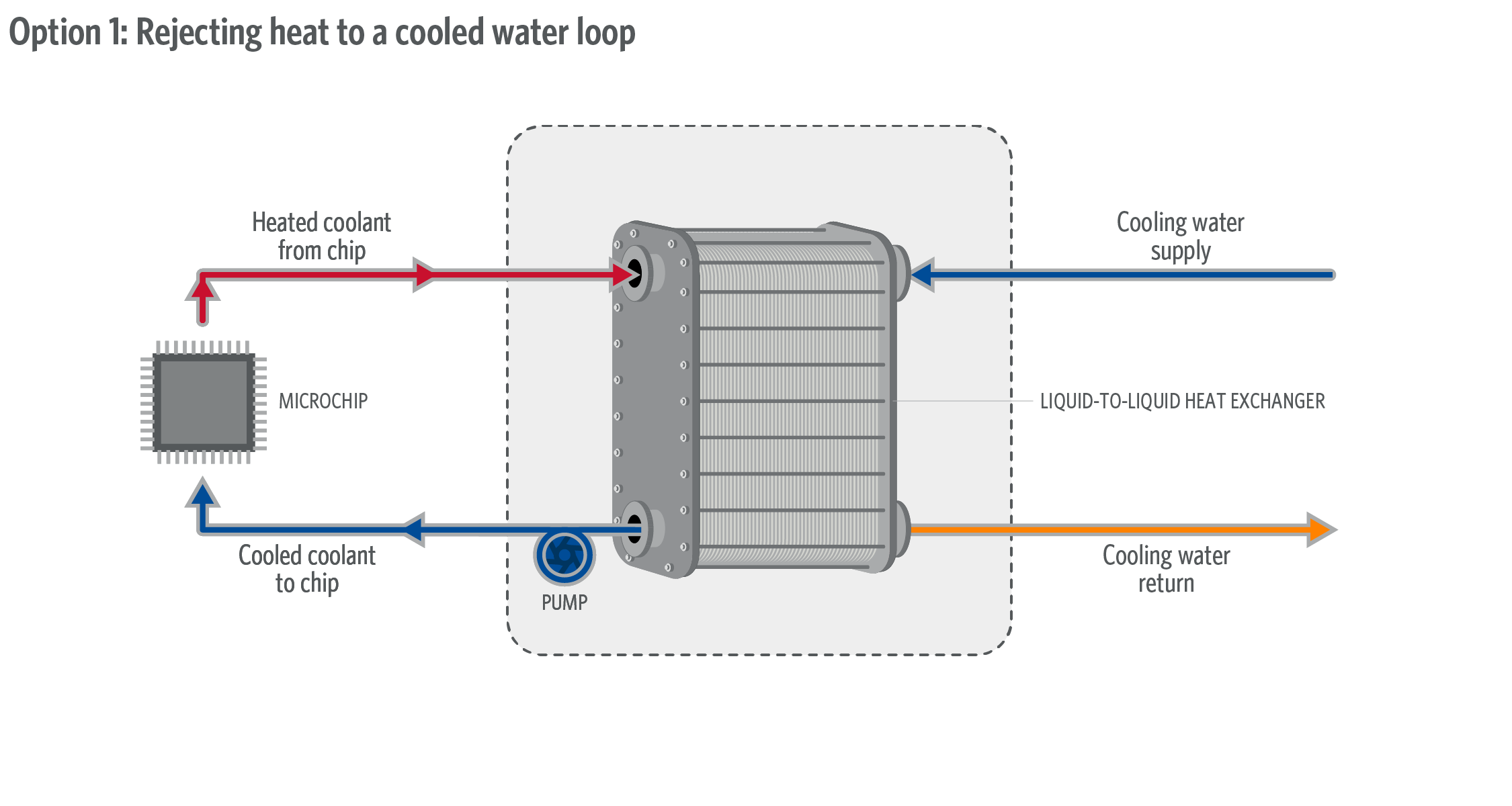
- Direct-to-Chip (D2C) Liquid Cooling: Coolant circulates through cold plates attached directly to high-heat components (CPUs, GPUs). Heat is transferred to a liquid loop and rejected via heat exchangers.
- Immersion Cooling: Servers are submerged in non-conductive dielectric fluid (single-phase or two-phase), which absorbs heat and is circulated or evaporated for cooling.
Liquid systems enable higher power densities, reduced fan energy, and lower facility cooling requirements, though they introduce complexity in fluid management and maintenance.
READ ALSO:
What Is a Data Centre? A Complete Beginner’s Guide

Efficiency Metrics: Power Usage Effectiveness (PUE)
Power Usage Effectiveness (PUE) measures data centre energy efficiency by dividing total facility power by IT equipment power.
- Formula: PUE = (Total Facility Power) / (IT Equipment Power)
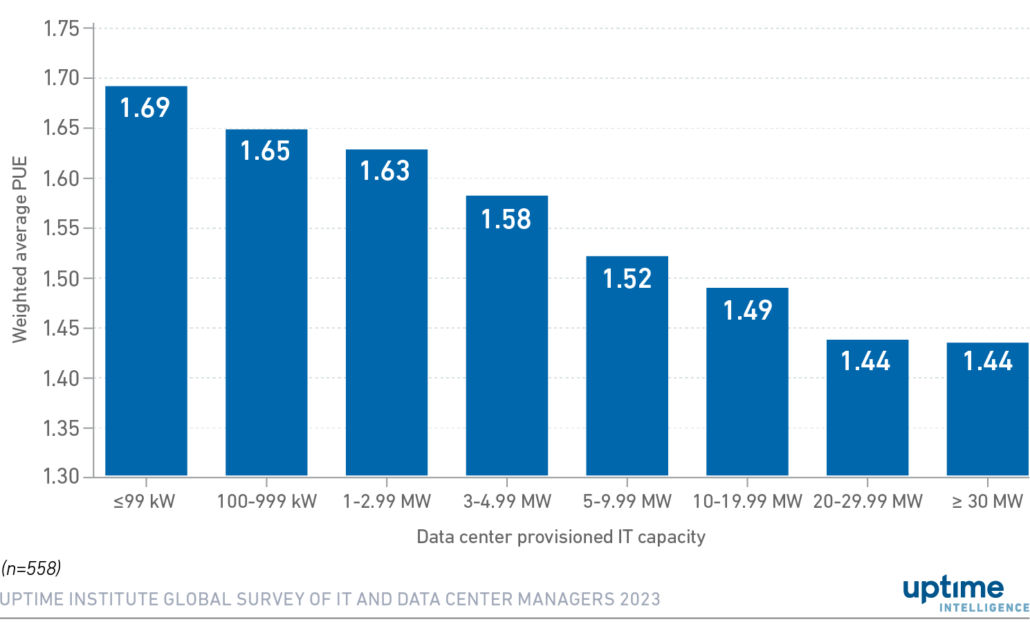
- Ideal Value: Approaches 1.0 (all power used by IT); typical modern facilities achieve 1.4–1.6, with hyperscale operations often below 1.3.
- Interpretation: A PUE of 2.0 means non-IT loads (primarily cooling) consume as much power as the servers themselves.
Improvements in containment, higher supply temperatures, free cooling, and liquid technologies drive PUE reductions.
Effective data centre cooling relies on a combination of proven air-based techniques such as CRAC/CRAH units and hot/cold aisle containment and emerging liquid cooling solutions tailored to high-density requirements.
These systems, when optimised, significantly enhance energy efficiency as quantified by PUE. Selection of the appropriate cooling approach depends on rack density, climate, capital constraints, and sustainability goals.
Ongoing advancements in containment strategies and liquid technologies continue to improve thermal performance while reducing operational costs and environmental impact.
Ronnie Paul is a seasoned writer and analyst with a prolific portfolio of over 1,000 published articles, specialising in fintech, cryptocurrency, climate change, and digital finance at Africa Digest News.