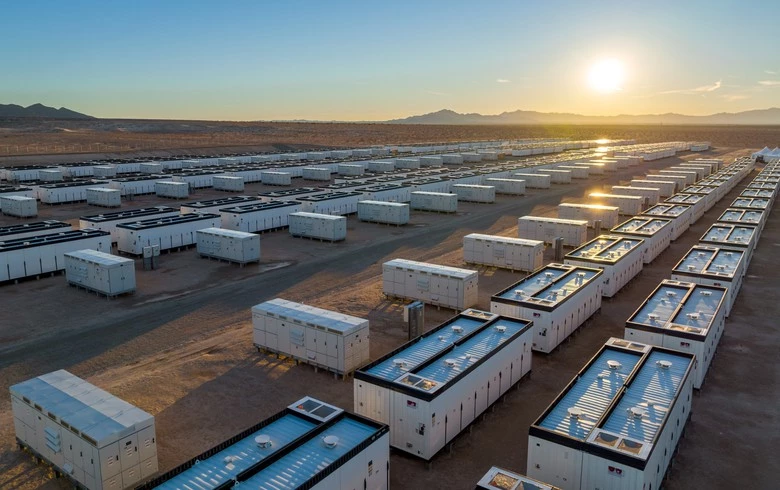
Mulilo has reached financial close on the Hartebeesfontein Battery Energy Storage System, a 77 MW / 308 MWh facility near Klerksdorp in the North West Province, marking the company’s fifth project to reach financial close in 2026.
Awarded under Bid Window 2 of South Africa’s BESS IPP Procurement Programme, the project is part of a larger story: Mulilo secured five of the eight projects in that bid window, establishing itself as the single most consequential private sector actor in South Africa’s grid-scale battery storage buildout.
Five of Eight: The Scale of Mulilo’s Mandate
The Mulilo Hartebeesfontein BESS financial close involving Norfund and Copenhagen Infrastructure Partners in 2026 is the culmination of a systematic programme rather than an isolated transaction.
Winning five of eight projects in a single bid window is not a fortunate outcome.
It reflects a procurement track record, development capability, and investor relationships that allowed Mulilo to compete credibly across the full breadth of what Bid Window 2 offered.
The South Africa BESS IPP Procurement Programme Bid Window 2 represents government policy translated into contracted infrastructure.
The programme exists because grid stability in South Africa requires storage capacity that can absorb surplus renewable generation and dispatch it when demand peaks or generation falls.
Battery storage is the missing piece between intermittent renewable capacity and a reliable grid, and Mulilo’s five-project sweep positions the company at the centre of that transition.
What the Hartebeesfontein BESS Delivers
The Hartebeesfontein facility will supply ancillary services to the National Transmission Company of South Africa under a 15-year power purchase agreement.
Its 308 MWh of storage capacity working alongside the 77 MW installation gives the grid a resource that can respond to frequency deviations, support voltage stability, and smooth the output variability that renewable energy introduces into the system at scale.
For the North West Province and the broader grid region it connects to, Hartebeesfontein represents infrastructure that underpins everything else.
Renewable energy generation without storage is an asset that produces power when conditions allow. Renewable energy generation paired with storage produces power when the grid needs it, which is a fundamentally different and more valuable capability.
How Mulilo Is Building South Africa’s Battery Storage Infrastructure
Mulilo is building South Africa’s battery storage infrastructure through collaboration between public policy, private capital, and development finance institutions that each bring something the others cannot provide independently.
READ ALSO:
Copenhagen Infrastructure Partners-Backed Mulilo Reaches Financial Close
Copenhagen Infrastructure Partners brings specialist renewable infrastructure investment expertise and international capital.
Norfund brings development finance credibility and the risk appetite to enter South African energy projects at a moment when policy certainty and grid stability remain contested issues.
Reatile Group brings local ownership and operational knowledge that grounds the project in the South African context the policy framework was designed to serve.
Reatile Group CCO Sunette Smith captured the significance of the financial close as a tangible demonstration of what South Africa Inc. can achieve when capital, policy, and execution align.
That alignment is harder to achieve than any individual element suggests. Policy frameworks exist for years before private capital commits.
Capital commitments are made before execution teams deliver.
Financial close is the moment those three elements converge into a contracted, funded infrastructure project that will be built.
South Africa’s Renewable Energy Storage Imperative
South Africa’s renewable energy storage challenge is structural.
The country has committed to a significant expansion of solar and wind capacity through the Renewable Energy Independent Power Producer Procurement Programme, but the intermittency of those technologies creates grid management complexity that storage infrastructure must address.
Without adequate South Africa battery energy storage capacity, the renewable generation expansion risks producing a grid that is less stable rather than more sustainable.
Mulilo’s fifth renewable energy financial close for South Africa grid stability in 2026 is one answer to that challenge.
Five projects reaching financial close in a single calendar year, all within the same bid window, represents a deployment pace that matches the urgency of the energy transition rather than defaulting to the slower rhythms of infrastructure development in complex regulatory environments.
From Financial Close to Grid Impact
South Africa’s IPP battery storage programme in 2026 will ultimately be judged not on financial closes but on megawatt hours dispatched, frequency events managed, and grid stability sustained across seasons of variable renewable generation.
Financial close is the enabling event. Construction, commissioning, and operation are where the infrastructure earns its purpose.
CEO Jan Fourie pointed to the hard work of the Mulilo team and the critical role of collaboration in reaching this milestone, framing the fifth financial close not as a finish line but as the beginning of the delivery phase.
For South Africa’s energy transition, that delivery phase is what matters most. Mulilo has now contracted the infrastructure to participate in it at a scale that few private developers in the country can match.