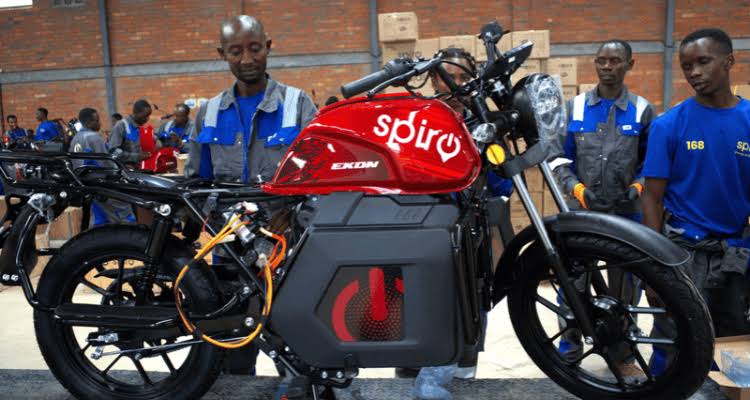
Spiro, Africa’s largest electric mobility company, officially launched its first 100 electric motorcycles in Ghana on 20 October 2026, introducing the Ekon 450 M1 V3 two-wheeler and battery-swapping infrastructure to the Ghanaian market.
The launch, held under the theme “The First 100: Powering a New Era of Mobility in Ghana,” featured a convoy of 100 electric motorcycles through Accra, a symbolic key handover to the first ten riders, and live battery-swapping demonstrations at Accra Mall.
The deployment targets commercial riders and delivery fleets in Greater Accra.
The Ekon 450 M1 V3: What Ghana’s First Riders Are Getting
The Ekon 450 electric motorcycle entering Ghana in 2026 is the same model Spiro has deployed across its existing African markets, purpose-engineered for the commercial riding conditions that define motorcycle transport in African cities.
Maxwell Dodd, Managing Director of Spiro Ghana, framed the launch around a practical argument rather than an aspirational one: cleaner, more affordable transport is no longer a vision for the future but a reality riders can experience today.
The economic case underpins that claim. Spiro riders across existing markets save up to USD 2 per day compared to conventional petrol-powered motorcycles, with the company reporting that its electric motorcycles can help riders cut operating costs by up to 40%.
For commercial riders in Accra whose daily earnings are directly tied to how much they spend on fuel and how much time they lose to maintenance, that saving is not marginal. It is the core reason to switch.
How Spiro’s Battery-Swapping Model Works in Ghana
Battery swapping in Ghana follows the same operational model Spiro has built across its seven existing African markets.
Rather than waiting for a motorcycle to recharge, which can take several hours, riders exchange a depleted battery for a fully charged one at a Spiro swap station in two minutes.
The swap is priced to be competitive with petrol, and the depleted battery is charged at the station for the next rider.
That two-minute swap time is the feature that makes the model commercially viable for commercial riders who cannot afford extended off-road periods.
A bodaboda rider in Nairobi or a delivery rider in Accra measures earning potential in hours on the road.
A charging model that removes two or more hours of productive riding time per day is a commercial liability. A swap model that takes the same time as a petrol fill is not.
Spiro currently operates over 135,000 electric motorcycles and more than 2,500 battery-swapping stations across Kenya, Rwanda, Uganda, Togo, Benin, Nigeria, and Cameroon, with over 54 million battery swaps completed and more than 2.5 billion kilometres of low-carbon travel achieved.
Ghana is the eighth market and the second in West Africa after Nigeria.
Why Ghana and Why Now
Spiro’s Ghana entry in 2026 follows the $215 million equity fundraise completed in June 2026 and the appointment of Anant Badjatya as Group CEO, both of which signal a company moving from proving its model to scaling it systematically across the continent.
The ambition is to reach 20 African markets, and Ghana’s profile fits the expansion logic: a rapidly growing two-wheeler market, increasing demand from commercial riders and delivery fleets, a government with stated interest in cleaner transport solutions, and continued investment in energy infrastructure.
Kaushik Burman, CEO of Mobility at Spiro, described Ghana as representing a major opportunity for electric mobility, with the first 100 motorcycles marking the beginning of Spiro’s ambition to make electric mobility accessible at scale across the country.
READ ALSO:
Spiro Strengthens Position in Africa’s EV Market With $215 Million Investment
Beyond the immediate deployment, Spiro has announced plans to assemble electric motorcycles locally in Ghana, following the manufacturing and assembly model it operates in Kenya, Rwanda, and Uganda.
Local assembly reduces import costs, shortens the supply chain, and creates the kind of in-country industrial presence that distinguishes Spiro’s approach from importers who simply distribute foreign-built vehicles.
Ghana’s Electric Mobility Context
Ghana’s motorcycle market is large and growing, driven by the same urban mobility dynamics that have made boda bodas and okadas central to city transport across sub-Saharan Africa.
Petrol prices have been volatile, making the case for lower and more predictable energy costs stronger than it was even two years ago.
The government has signalled interest in electric mobility as part of its broader energy transition agenda, and several smaller operators have tested electric motorcycles in Accra before Spiro’s arrival.
What Spiro brings that smaller operators cannot replicate is the battery-swapping network.
An electric motorcycle without access to convenient, affordable charging or swapping is not a commercial proposition for a rider who depends on it full-time.
The integrated model, where Spiro supplies both the motorcycle and the swap infrastructure, removes that dependency risk and gives riders a complete ecosystem rather than a vehicle in search of energy infrastructure.
What the First 100 Represent
The first 100 motorcycles in Ghana are, in Spiro’s own framing, a beginning rather than a milestone to be counted and closed.
Following the launch, the company will continue engaging prospective customers through test rides and demonstrations across Greater Accra, building the rider base and the commercial data that justify the next phase of network expansion beyond the capital.
For Ghana’s electric mobility sector, Spiro’s entry changes the competitive landscape.
A company with 135,000 deployed motorcycles, 2,500 swap stations, and 54 million completed swaps in seven markets brings operational credibility that makes the technology argument unnecessary.
The question is no longer whether battery-swapping electric motorcycles can work in African conditions. The question is how quickly Ghana’s commercial riders will adopt them.


