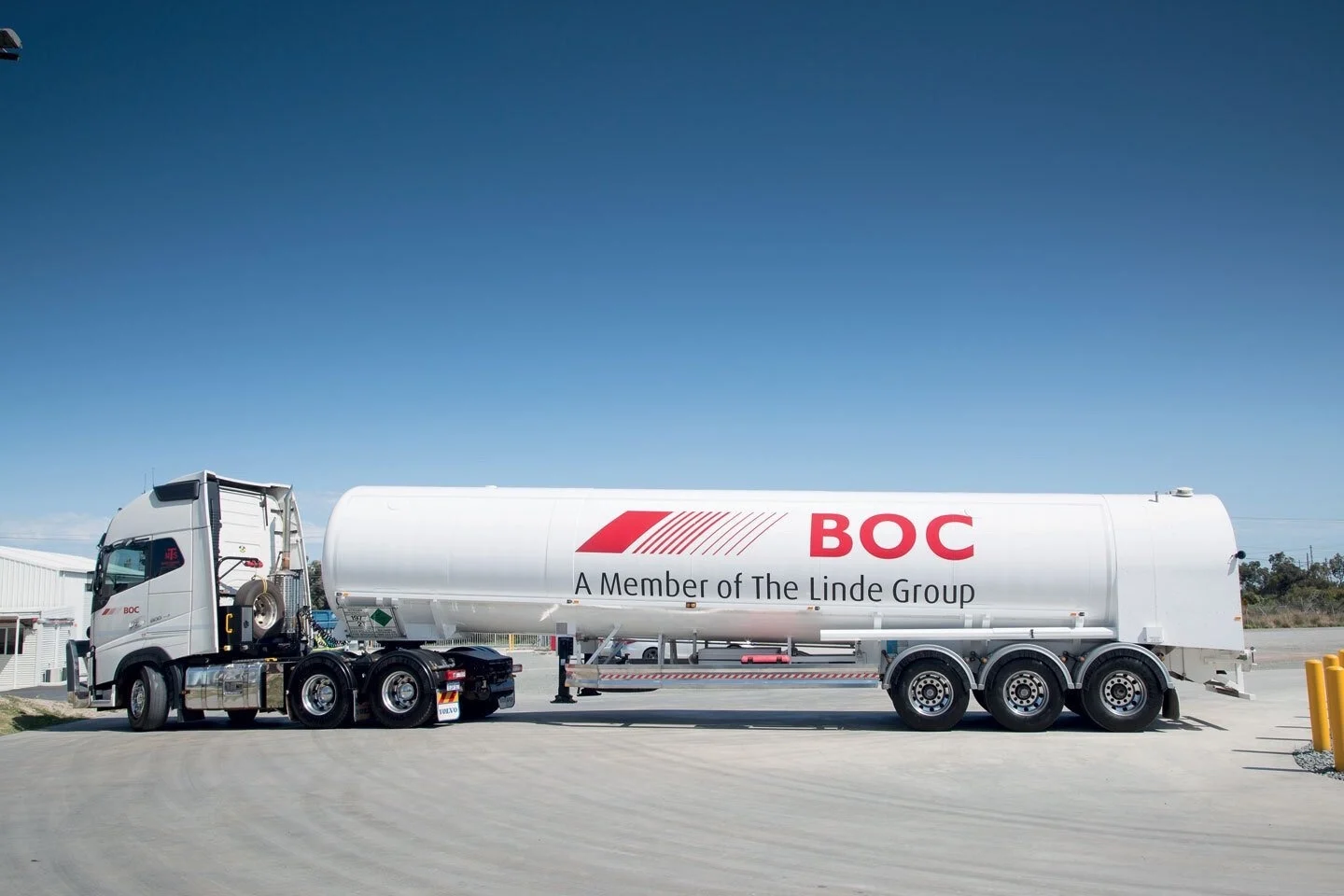
BOC Kenya carries one of the longest corporate lineages of any company in this series, tracing back to a patent taken out by two French brothers in 1880s London.
It’s also, quite recently, become an accidental case study in shareholder activism, after minority investors successfully fought off a four-year takeover attempt by a fellow NSE-listed rival. Here’s the full picture.
History and Founding Story
BOC Kenya’s ultimate parentage traces back to 1886, when French brothers Arthur and Leon Brin founded Brin’s Oxygen Company in London, commercialising a patented process for separating oxygen using a high temperature barium oxide method.
Scottish foreman Kenneth Sutherland Murray redesigned the plant in its first year, dramatically increasing output, and by 1890 the company had introduced the steel gas cylinder, a containment innovation that became the global standard and let the company begin exporting oxygen internationally.
In 1906, the company renamed itself the British Oxygen Company, or BOC, growing over the following decades into a major international industrial gas group; it acquired Airco Industrial Gases in 1978 and became part of the FTSE 100 Index.
BOC’s Kenyan operations began on 9 December 1940, when the company established itself in Mombasa, expanding to Nairobi in 1947 and later to Kisumu, Kampala, Mwanza, and Dar es Salaam, building a genuinely regional East African footprint decades before most of the businesses in this series existed.
BOC Kenya listed on the Nairobi Securities Exchange in 1969, the same year as fellow British-founded industrial company BAT Kenya.
The global BOC Group’s own corporate story took a significant turn in 2006, when the German industrial gases and engineering company Linde acquired BOC Group in a landmark transaction, after Linde and BOC “joined forces” following a series of competing bids from rivals Air Products and Chemicals and L’Air Liquide back in 1999.
That put BOC Kenya’s ultimate ownership in the hands of Linde plc (itself later formed through the 2019 merger of Linde AG and Praxair), one of the world’s largest industrial gas companies.
More recently, and most dramatically for shareholders, BOC Kenya spent nearly four years, from November 2020 until the deal’s eventual collapse, as the target of an unsolicited takeover bid from fellow NSE-listed carbon dioxide manufacturer Carbacid Investments and its controlling shareholder Aksaya Investments, an offer valued at roughly KSh1.2 billion that was ultimately withdrawn after opposition from minority shareholders, including prominent BOC shareholder Ngugi Kiuna.
Core Business Lines / Revenue Streams
BOC Kenya manufactures and markets industrial, medical, and specialty gases, alongside related equipment, welding products, and engineering services, serving customers across critical sectors of the Kenyan and regional economy.
- Industrial gases: Core products including oxygen, nitrogen, air, argon, hydrogen, acetylene, and shielding gases used across manufacturing, food processing, energy, and research sectors.
- Medical gases: Oxygen and other medical grade gases supplying Kenya’s healthcare sector, a segment the company itself describes as supporting critical, sometimes life-sustaining, national infrastructure.
- Specialty gases: A range of niche products including helium, mining calibration mixtures, refrigerants, laser gas, and scientific mixtures for specialised industrial and research applications.
- Welding and related products: Packaged chemicals and fire suppression equipment, alongside welding gases and consumables, supporting Kenya’s manufacturing and construction sectors.
- Liquefied petroleum gas (LPG) and propane: Additional fuel gas products rounding out the company’s broader portfolio.
- Customer engineering projects: A notable, and recently volatile, revenue line: one-off engineering projects for large customers have periodically driven substantial swings in reported revenue, contributing strongly to growth in some periods and creating year-on-year declines when such projects aren’t repeated.
- Regional operations: BOC Kenya operates subsidiaries including East African Oxygen Limited, BOC Tanzania, and BOC Uganda Limited, giving it a footprint across Kenya, Uganda, and Tanzania.
Competitive Position in Its Industry
BOC Kenya holds a leading position in East Africa’s industrial and medical gas market, backed by the technical expertise, scale, and global reach of its ultimate parent, Linde plc, widely regarded as the world’s largest industrial gas supplier by market share and revenue.
That backing gives BOC Kenya access to research, engineering standards, and safety practices that a purely local competitor would struggle to match, even as it competes in a market where Carbacid Investments (which itself counts Linde plc as a minority shareholder, an unusual overlap given Carbacid’s own attempted acquisition of BOC) remains a significant regional rival, particularly in carbon dioxide specifically.
BOC Kenya’s recent financial performance has been notably volatile, largely because of the swing in one-off engineering project revenue.
Full year 2025 results were strong, with revenue rising 19% to KSh1.43 billion and profit after tax surging 48%, on the back of increased demand for medical and industrial gases plus significant customer engineering project work; the company followed that with a record total dividend of KSh12.85 per share for the year, its largest payout in company history.
That momentum reversed sharply in the first half of 2026, though: revenue fell 17.2% to KSh600 million and net profit dropped 39.8% to KSh100.4 million, a decline the company attributed directly to the absence of the once-off customer engineering projects that had boosted the prior year’s figures, compounded by a 17% rise in distribution, selling, and administrative expenses tied to inflation and higher fuel and energy costs.
Management has said the business’s shift back toward its core, more predictable gas business (rather than lumpy project revenue) is gaining momentum heading into the second half of 2026, which it expects to support more sustainable revenue growth and earnings quality going forward.
READ ALSO:
Inside the NSE: Carbacid Investments (CARB)
Despite the profit decline, the company’s underlying financial position actually strengthened during this period: cash generated from operations rose 40.3%, cash and cash equivalents grew to KSh1.29 billion, and total assets and equity both increased, giving the board confidence to actually raise its interim dividend even as reported earnings fell, a reminder that reported profit and underlying cash generation don’t always move in lockstep.
Ownership Structure
BOC Kenya is majority owned by its long standing global parent, with a notable, concentrated local minority shareholder whose opposition proved decisive in blocking the Carbacid takeover attempt.
- BOC Holdings (UK), part of the Linde Group: The controlling shareholder, holding a 65.38% stake (some sources cite a closely aligned 65% figure), reflecting BOC Kenya’s status as a genuine subsidiary of one of the world’s largest industrial gas multinationals.
- Ngugi Kiuna: A prominent individual shareholder holding 17.91% of the company, making him easily the largest non-institutional shareholder and the most vocal, publicly identified opponent of the 2020 to 2024 Carbacid and Aksaya takeover attempt, a stake large enough to meaningfully influence the outcome of any future takeover approach.
- Other individual and corporate shareholders: The remaining roughly 16.91% is held by a mix of smaller individual and institutional investors trading on the NSE.
Why It’s Listed on the NSE Specifically
BOC Kenya’s 1969 NSE listing reflects a similar rationale to that of BAT Kenya and other long-established multinational subsidiaries of that era: giving a well-capitalised foreign parent a transparent, locally regulated vehicle to raise capital, demonstrate commitment to the Kenyan market, and allow Kenyan investors to hold a stake in a business built on genuinely global industrial expertise, while the parent retained firm majority control.
The listing has proven its practical value most vividly in recent years, not through a capital raise, but through the Carbacid takeover saga: as a publicly listed company, BOC Kenya’s minority shareholders, led by Ngugi Kiuna, had the standing, the visibility, and the regulatory protections to publicly oppose a bid they viewed as undervaluing the company, and ultimately to see that opposition prevail when Carbacid and Aksaya withdrew their offer.
That outcome, and the subsequent doubling of BOC’s share price once the deal collapsed, stands as one of the more concrete, real-world demonstrations in this entire series of what an NSE listing’s minority shareholder protections can actually achieve in practice.
Current Stock Price
BOC Kenya’s share price has moved substantially over the past couple of years, having roughly doubled after the Carbacid takeover bid was withdrawn.
The stock began 2025 around KSh88.75 and had reached KSh100.50 by around September 2025 (a 10.7% single-day jump on the back of strong half-year earnings), with a market capitalisation of approximately KSh1.96 billion at that point.
Given the substantial share price gains reported since the failed takeover, and the company’s subsequent volatile 2026 half-year results, investors should expect meaningful price movement around each set of results.
Share prices move daily, and BOC Kenya specifically has shown notable single-day volatility around its earnings announcements. For a live quote, check the NSE’s official market data page or a licensed brokerage platform before making any decisions.
How to Buy BOC Kenya Shares
You don’t need to be in Kenya to buy BOC shares; it can be bought locally or from abroad:
- Open a CDS (Central Depository System) account. This is Kenya’s electronic share registry account, required to hold any NSE listed stock. It’s opened through a licensed stockbroker or investment bank.
- Choose a licensed NSE stockbroker or investment bank. Examples include firms like Standard Investment Bank, AIB-AXYS Africa, Genghis Capital, and Faida Investment Bank. A full list of licensed trading participants is available on the NSE website.
- Fund your trading account via bank transfer, mobile money (M-Pesa is widely supported), or card, depending on the broker.
- Place an order for BOC through the broker’s trading platform, app, or by instructing your broker directly, specifying the number of shares or amount you want to invest. Note that BOC Kenya’s trading liquidity has been relatively modest (recent 12-month indicative trading liquidity was estimated at around US$814,590), so larger orders may take time to fill at a stable price.
- For non resident and diaspora investors, several online platforms (such as mystocks.africa and similar cross border brokerages) let you open an account remotely, fund it in USD or your local currency, and buy NSE listed shares like BOC without needing an in country presence, though you should confirm licensing and custody arrangements before using any platform.
- Hold and track. Shares are held electronically in your CDS account. BOC Kenya has one of the most generous and consistently rising dividend records among smaller NSE counters: the per-share payout rose from KSh6.05 in 2022 and 2023, to KSh8.65 in 2024, to a record KSh12.85 for 2025 (representing roughly 80.7% of that year’s net earnings), and the board further raised the 2026 interim dividend to KSh4.00 per share (up from KSh2.50 the year before) even as half-year profit declined, paid out directly to your linked bank account.
This profile is for informational and editorial purposes and is not investment advice. Stock prices, especially, change constantly, so always verify current figures with the NSE or a licensed broker before making any investment decision. Other figures reflect the most recent publicly reported data as of 2026 and may change with new financial disclosures.